Conception Date Calculator
Empowering mothers with precise, clinical-grade pregnancy timelines and growth tracking. Sync your dates instantly to our Gynosakhi App for AI-driven obstetric care.
Estimate the exact date your baby was conceived based on your due date or LMP.
Our pregnancy algorithms, trimester calculations, and health insights are constructed based on peer-reviewed clinical guidelines and approved by certified medical practitioners.
Calculations adhere to standard clinical guidelines set by the American College of Obstetricians and Gynecologists.
All symptom data, logs, and profile records inside our applications are encrypted and kept strictly confidential.
Medical resources are written and periodically updated by an expert board of OB-GYNs and child care advisors.
See how expecting parents use our calculators and Gynosakhi AI daily to support their pregnancy milestones.
"The gestational calculator gave me the exact due date that my OB-GYN later confirmed. Using the Gynosakhi app is like having a physician in the family — I get answers in seconds whenever I'm anxious."
"I track my weeks with the timeline widget on this site and read the week-by-week guides constantly. The app's AI chatbot is amazing at listing which medications are safe during the first trimester."
"Best IVF calculator out there. The 3-day and 5-day transfer inputs are accurate down to the day. Syncing the dates into Gynosakhi was extremely smooth!"
For many parents, knowing the estimated date of conception is a meaningful detail. It helps tell the story of when their pregnancy journey began. In clinical obstetrics, doctors focus on your due date and gestational weeks, but using these dates, we can reverse the math to estimate when fertilization occurred.
This article explains the biology of conception, how to back-calculate your conception date from your due date or LMP, and how to verify these windows.
A full-term human pregnancy lasts approximately 38 weeks (266 days) from the moment of fertilization to birth. If you know your estimated due date (EDD), we can perform simple subtraction to find your conception date:
For example, if your due date is October 24, subtracting 266 days places your conception date around January 31. Because sperm can survive for several days inside the fallopian tubes, the intercourse that led to pregnancy likely occurred within a 5-day window leading up to this date.
It is a common misconception that pregnancy begins immediately after intercourse. The biological sequence is a journey that takes several days:
Whether you conceived naturally, tracked ovulation, or went through IVF, monitoring your gestational progress is key to a healthy pregnancy. Download the Gynosakhi app on iOS or Android to access daily developmental milestones, safety logs for medicines, and direct AI obstetrician chatbot consultation.
Clinical Disclaimer: The calculations, timelines, and guides provided on this page are for educational and planning purposes only. They are based on clinical standards from ACOG, but do not replace professional medical advice, diagnosis, or clinical ultrasound assessments from your OB-GYN.
Download Gynosakhi to get 3D ultrasound visualizers, daily nutrition plans, and 24/7 AI obstetric assistance.
More than just a calculator. A comprehensive 24/7 medical support system for your entire maternity journey.
Get instant, medically-reviewed answers to all your pregnancy, diet, and lifestyle questions, anytime day or night.
Tailored meal plans depending on your gestational stage, symptoms, cravings, and nutritional requirements.
Record daily symptoms and monitor baby movement patterns. Generate clinical reports to share with your obstetrician.
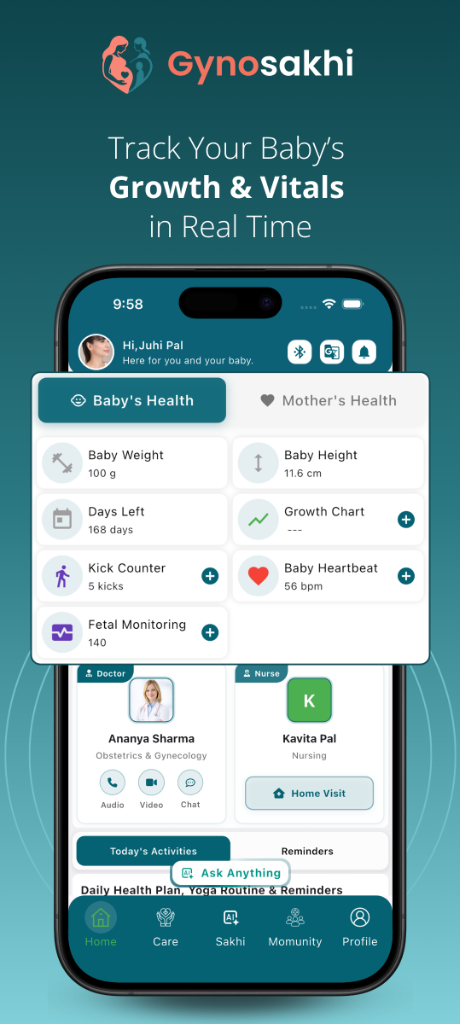
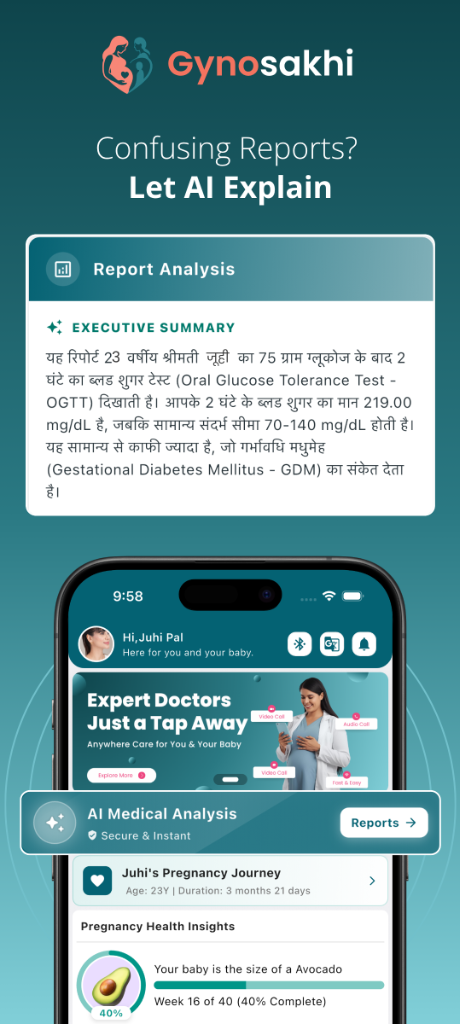
Track your baby's growth, get clinical reports analyzed by advanced Medical AI, log symptoms, count kicks, and consult expert OB-GYNs. Download our free, HIPAA-secure app today.
Medical answers to standard queries regarding pregnancy calculations, due dates, and trimester guidelines.
Pinpointing the exact hour or day of conception is difficult because sperm can live inside the female body for up to 5 days, and the egg remains viable for 24 hours. This means conception could have occurred several days after intercourse. Our calculator provides a highly accurate 5-day conception window based on your due date.
Not necessarily. If you have intercourse on a Monday, but do not ovulate until Thursday, fertilization (conception) will likely occur on Thursday or Friday, once the egg is released.
Even with an ultrasound scan, a medical provider cannot determine the exact date of conception. They can, however, determine the gestational age of the fetus within a few days of accuracy, which is used to establish your due date.
A standard human pregnancy lasts approximately 38 weeks (266 days) from the moment of fertilization to birth. To calculate your conception date from your estimated due date, the algorithm subtracts 266 days directly from your EDD.
For women with a standard 28-day cycle, ovulation and conception typically occur 14 days after the first day of their Last Menstrual Period. Our calculator estimates the conception date by adding 14 days to your LMP, adjusting for variations in your cycle length.
Standard models assume ovulation occurs on day 14 of a 28-day cycle. If you have a longer cycle, say 32 days, you likely ovulated and conceived around day 18. If your cycle is shorter, say 24 days, you likely ovulated around day 10. Our tool adjusts these timelines accordingly.
Fertilization occurs when a sperm cell successfully penetrates the egg in the fallopian tube, creating a zygote (this is the biological moment of conception). Implantation occurs 6 to 12 days later, when this developing cell cluster attaches to the lining of the uterus to start the pregnancy.
Yes, healthy sperm can survive inside the female reproductive tract (cervical mucus and fallopian tubes) for up to 5 days. This is why having intercourse several days before ovulation can still lead to successful conception.
While the conception date narrows down the window of fertilization, it cannot verify paternity if you had multiple partners within the same fertile window (due to sperm survival rates up to 5 days). A clinical DNA paternity test is the only medically definitive method to determine paternity.
Yes. For IVF pregnancies, the conception date is biologically determined by the transfer date and the age of the embryo. For a 5-day blastocyst transfer, the conception date is 5 days before the transfer. For a 3-day embryo transfer, it is 3 days before the transfer.