Plan and Prepare with the Baby Due Date Calculator
Finding out you are expecting is an exciting milestone. One of the first questions on every parent's mind is: When will the baby arrive? Our Baby Due Date Calculator uses clinically validated standards, aligned with the guidelines of the American College of Obstetricians and Gynecologists (ACOG), to help you determine your estimated delivery date (EDD).
By entering the first day of your last menstrual period (LMP) and your average cycle length, or your conception date, or IVF transfer details, this calculator determines your due date and provides a detailed breakdown of your current trimester progress and baby size analogy.
The Purpose of Knowing Your Due Date
An accurate Estimated Due Date (EDD) is the cornerstone of your prenatal care. It is not just about counting down the days; it serves several critical clinical and practical purposes:
- Scheduling Prenatal Screenings: Key diagnostic tests, such as the nuchal translucency scan (weeks 11-13) and the anatomy ultrasound (weeks 18-22), must be performed at precise gestational intervals.
- Tracking Fetal Development: Knowing your exact gestational week allows your doctor to compare your baby's growth measurements against standard fetal growth curves.
- Planning for Labor and Delivery: It helps you organize your hospital bag, plan maternity leave, coordinate birth plans, and prepare your nursery.
Calculator Inputs and Logical Formulas
Our calculator supports three common clinical calculation methods depending on the data you have available:
- Last Menstrual Period (LMP) & Cycle Length: This utilizes Naegele's Rule, which calculates the due date by adding 280 days (40 weeks) to the first day of your last period, adjusted by adding or subtracting the difference between your actual cycle length and the standard 28-day cycle.
Formula: EDD = LMP + 280 days + (Cycle Length - 28 days) - Date of Conception: If you know the exact date of conception (common for monitored ovulation cycles), the calculation adds 266 days (38 weeks) directly to that date.
Formula: EDD = Conception Date + 266 days - IVF Transfer Date: For IVF pregnancies, the due date is calculated based on the embryo transfer date and the embryo's age at transfer (3-day or 5-day).
Formula (5-Day Transfer): EDD = Transfer Date + 261 days
Formula (3-Day Transfer): EDD = Transfer Date + 263 days
Step-by-Step Instructions & Example Calculation
To compute your due date:
- Select your calculation method from the tabs (LMP, Conception, or IVF).
- Input the corresponding date.
- Adjust the cycle length slider if using the LMP method.
- Click Calculate Pregnancy Progress to view your results.
Example Calculation: If the first day of your last period (LMP) was October 1, 2025, and you have a regular 28-day cycle, our calculator adds 280 days to October 1, outputting an Estimated Due Date of July 8, 2026. If your cycle length was 30 days, the calculator adds an extra 2 days, making the due date July 10, 2026.
Interpreting Your Results
Once calculated, you will receive:
- Estimated Due Date: The date your baby is projected to arrive.
- Days Remaining: A countdown timer to your delivery day.
- Gestational Age: Your current week and day of pregnancy.
- Trimester: Which phase of pregnancy you are currently in.
- Baby Size Analogy: A fun and helpful fruit or vegetable comparison matching your baby's length and weight.
Benefits of the Gynosakhi Due Date Calculator
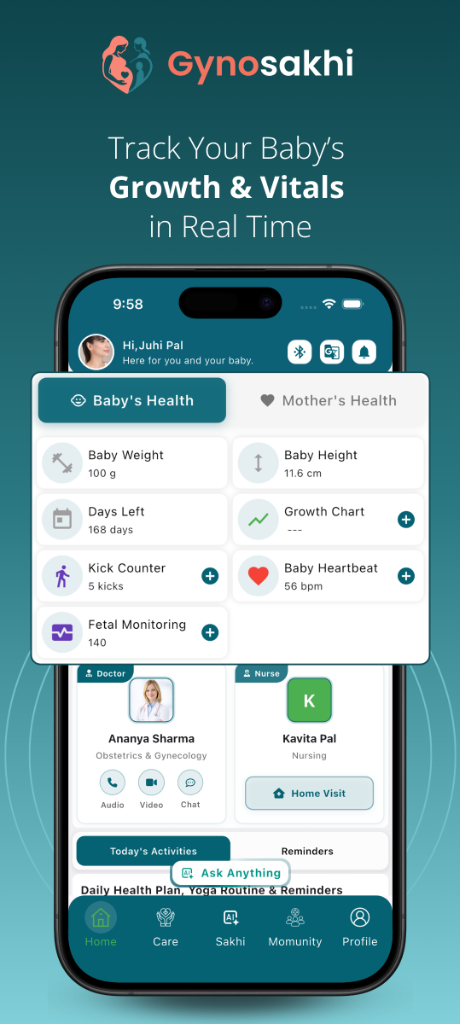
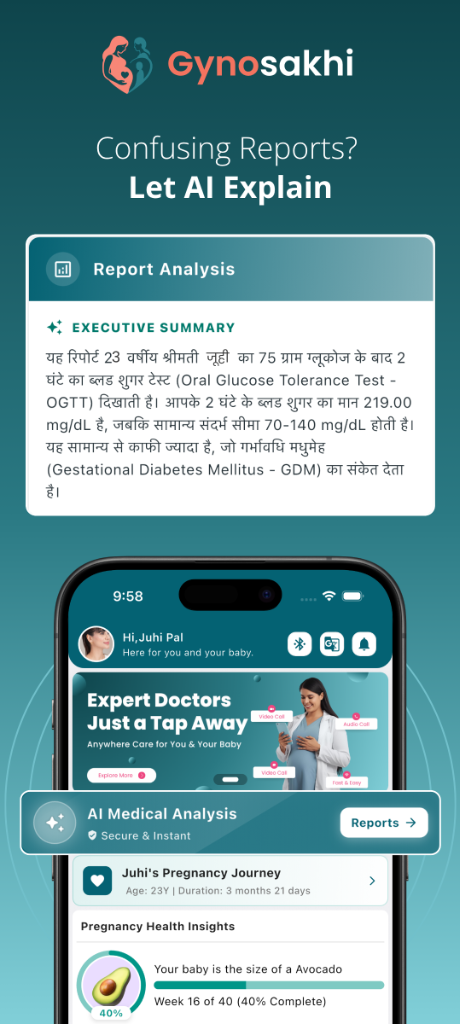
Unlike basic calculators, our tool is tailored to your unique cycle dynamics, accounts for IVF transfers, and syncs seamlessly with the Gynosakhi App ecosystem. Expecting mothers in India can monitor maternal updates, log daily symptoms, check medication safety scores, and receive guidance from our AI doctor assistant.
When to Consult Your Obstetrician
While this calculator provides an excellent starting estimate, you should schedule a prenatal appointment as soon as you get a positive pregnancy test. Your doctor will perform a physical exam and a first-trimester dating ultrasound (usually between weeks 8 and 12) to verify the fetal heartbeat and confirm your due date with high accuracy. Seek immediate medical attention if you experience severe cramping, heavy vaginal bleeding, or persistent vomiting.
Clinical Disclaimer: The calculations, timelines, and guides provided on this page are for educational and planning purposes only. They are based on clinical standards from ACOG, but do not replace professional medical advice, diagnosis, or clinical ultrasound assessments from your OB-GYN.
Get Daily Baby Developmental Milestones in Your Pocket
Download Gynosakhi to get 3D ultrasound visualizers, daily nutrition plans, and 24/7 AI obstetric assistance.